Why did Paul Gauguin go to Tahiti?
Paul Gauguin left Europe for Tahiti in search of simplicity and authenticity, hoping to establish a deep connection with nature and native cultures in french polynesia to renew his art. Nicknamed “The Indian” because of his childhood in Peru, he dreamed of escaping Western conventions.
A solitary departure
On March 31, 1891, he embarked alone after his wife Mette and five children had withdrawn, leaving behind a pregnant mistress. On his arrival in Papeete on June 9, his 43rd birthday, our “taatavahiné” (man/woman) discovered a disappointing colonial reality, being mocked for his bohemian appearance, especially his long hair.
Polynesian inspiration: Gauguin’s muses
In this new environment, Polynesian landscapes and people became the main sources of inspiration for his works, in vibrant colors ranging from golden yellow to indigo blue. Tahitian women, in particular, served as his models, although he had some controversial relationships, notably with a 13-year-old girl, Teha’amana, and other young girls he allegedly abducted, angering the natives.
A quest for authenticity in the Marquesas Islands
After several years in Tahiti, Gauguin moved to the Marquesas Islands and settled in Hiva Oa, where he continued to seek authenticity and inspiration in an unspoiled setting. His passion for ethnology led him to explore Polynesia, and he created works marked by “wild” figures. It was here that Van Gogh’s former friend began to discover the beauties and mysteries of Polynesian life.
Although he rejoined France in 1893 and suffered health problems, he returned to Tahiti in 1895 and settled with a young Tahitian woman. In 1901, he built the Maison du Jouir, continuing to paint while struggling against the colonial administration.
A controversial legacy

Gauguin died of a heart attack on May 8, 1903, and was buried in the Calvaire d’Atuona cemetery on the island of Hiva Oa alongside Jacques Brel, who joined him years later. His tomb was later renovated by the Société des Études Océaniennes (SEO) and Pierre Bompard.
Today, his works, though little appreciated by Marquesans, are a great success in Paris. His legacy remains contested due to his relationships with young girls and his exploitation of the premises, which has led to a reassessment of his history in the light of a postcolonial gaze.
Gauguin’s landmark works in Tahiti
The impact of Tahiti on Paul Gauguin’s work is undeniable, and many of his creations made on the island have become emblematic.
Where do we come from? What are we? Where are we going?, 1897
Among them, “Where do we come from? What are we? Where are we going?” is undoubtedly the most famous. This pictorial testament is a profound meditation on humanity’s great existential questions. Executed on a large canvas (55 × 147 inches), it is now housed at the Museum of Fine Arts, Boston.
This complex work reads from right to left, presenting a panorama of human life from birth to death. On the right, a baby symbolizes the beginning of life. In the center, figures in full activity represent adult life, while on the left, an old woman prepares for death.
The bold use of color and form reflects the influence of the tropical light and lush landscapes of Tahiti on his work.
La Orana Maria, 1891
La Orana Maria is a reinterpretation of the Virgin Mary and the Christ Child in a Tahitian setting. It is Paul Gauguin’s first major Tahitian work, inspired by the fusion of Christian and Polynesian beliefs. In this canvas, he depicts a yellow-winged angel showing Mary and Jesus, both Tahitian, to two almost naked local women draped only in a pareo.
Set against a backdrop of dark mountains and blossoming trees, the painting evokes the Annunciation and opens with the traditional Tahitian greeting, “Ia orana“.
Aha oe feii? (Are you jealous?), 1892
Gauguin depicts two Tahitian women sitting on the beach, illustrating their unique, impassive posture. He drew inspiration from their massive silhouettes and typical tropical languor, conveying a blend of mystery, animality and melancholy that characterizes his art.
To capture this essence, he uses preliminary studies based on direct observation, even incorporating elements of ancient art, such as the posture of a figure from a bas-relief in the Temple of Dionysus in Athens.
Places to visit in Polynesia for Gauguin enthusiasts

Tahiti and the Marquesas Islands offer several emblematic sites where the artist lived and worked. These sites, steeped in history, provide an insight into the influence of French Polynesia on his work.
The Paul Gauguin Museum in Tahiti
Located in Papeari, around 31 miles from Papeete, the Paul Gauguin Museum is a must-see for anyone wishing to explore the artist’s legacy. Surrounded by lush gardens, the museum features a collection of reproductions of his works, historical documents and personal objects.
Although Gauguin’s original pieces are scattered in museums around the world, this venue offers an immersion into his life and work in Tahiti. Temporary exhibitions and cultural events are also organized here, celebrating Gauguin’s lasting influence.
The Paul Gauguin Cultural Centre in Hiva Oa
For those wishing to explore further, a visit to the Paul Gauguin Cultural Centre in Hiva Oa, in the Marquesas Islands, is essential. This site offers an intimate perspective on his last works and writings (le manuscrit de Noa Noa), as well as his daily life in the remote archipelago.
Historical and natural sites
In addition to museums, several natural and historical sites in Tahiti and the Marquesas are associated with Gauguin. A visit to the reconstructed Maison du Jouir in Atuona offers a glimpse of his daily life and his final years as an artist.
Hiva Oa, nicknamed the “Garden of the Marquesas“, offers black sand beaches, hiking, diving and archaeological sites. Explore this island to discover Marquesan crafts and the landscapes that inspired the French painter.
In the footsteps of Paul Gauguin with Tahiti Travel Services

Cruises and excursions in French Polynesia
With Tahiti Travel Services, explore the atolls of the Tuamotu Islands, the lagoons of Bora Bora and the white sandy beaches of the Leeward Islands with our cruises and excursions adapted to all travelers.
Luxury activities and accommodation in Tahiti
Experience a luxurious Tahiti vacation with bungalows on stilts, diving in the crystal-clear waters to observe colorful fish, or hiking in the verdant mountains. Our accommodations range from five-star resorts to authentic guesthouses.
The richness of Polynesia
Dances, tattoos and traditional arts
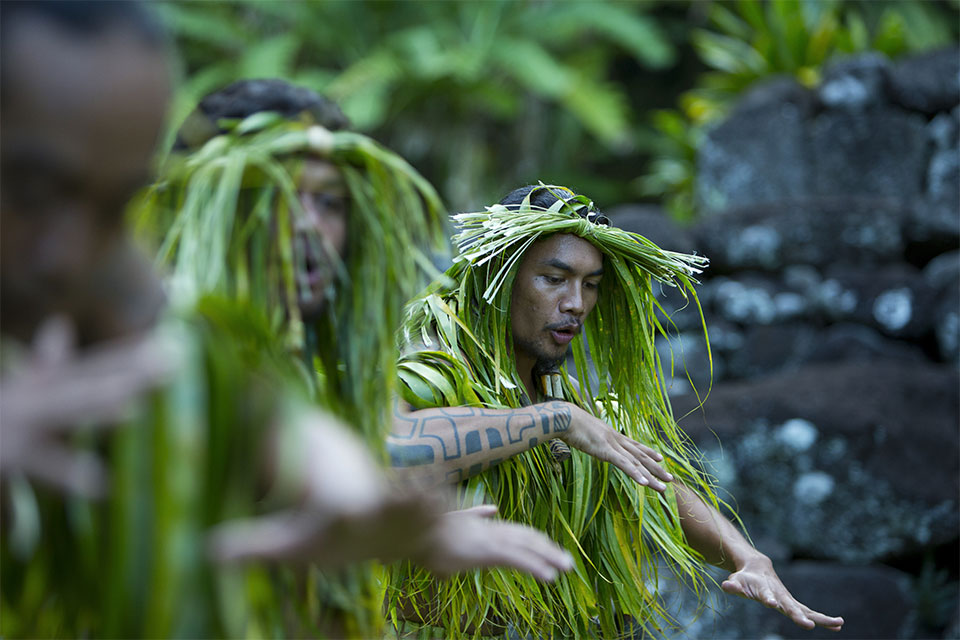
Discover Tahitian culture through Tahitian dance performances, traditional tattoo art and local art galleries. You’ll understand why Gauguin was fascinated by these islands.
Tahitian cuisine: a feast for the senses
Savor Tahitian gastronomy with dishes such as raw fish marinated in coconut milk, accompanied by Tahitian vanilla and tropical fruits. Explore Papeete’s local markets for fresh produce.
Discover authentic Tahiti with Tahiti Travel Services. From Papeete to the Marquesas Islands, from the Tuamotu atolls to the lagoons of Bora Bora, we offer personalized services to make your trip an unforgettable adventure. You’ll see the landscapes that inspired Paul Gauguin and meet the friendly locals who share Polynesian culture with you.
Book your trip to Tahiti now! And let yourself be carried away by the magic of the Pacific, in itself the most beautiful of creations.