Tahiti’s real name is not what you think!
Before the arrival of Europeans, Tahiti had several names, including Ta-hi Ta-hi (alone, surrounded by the sea) or Te-hi-to (ancient). Other theories suggest it comes from Ta-ha Ta-i, referring to a place in the middle of the sea. Each district even had its own name, like Papara, Mahina, or Hitia’a, anchored in local legends.
Western navigators, such as James Cook, transformed this identity into Otaheite before “Tahiti” became the name we use today.
Tahiti, the birthplace of overwater bungalows
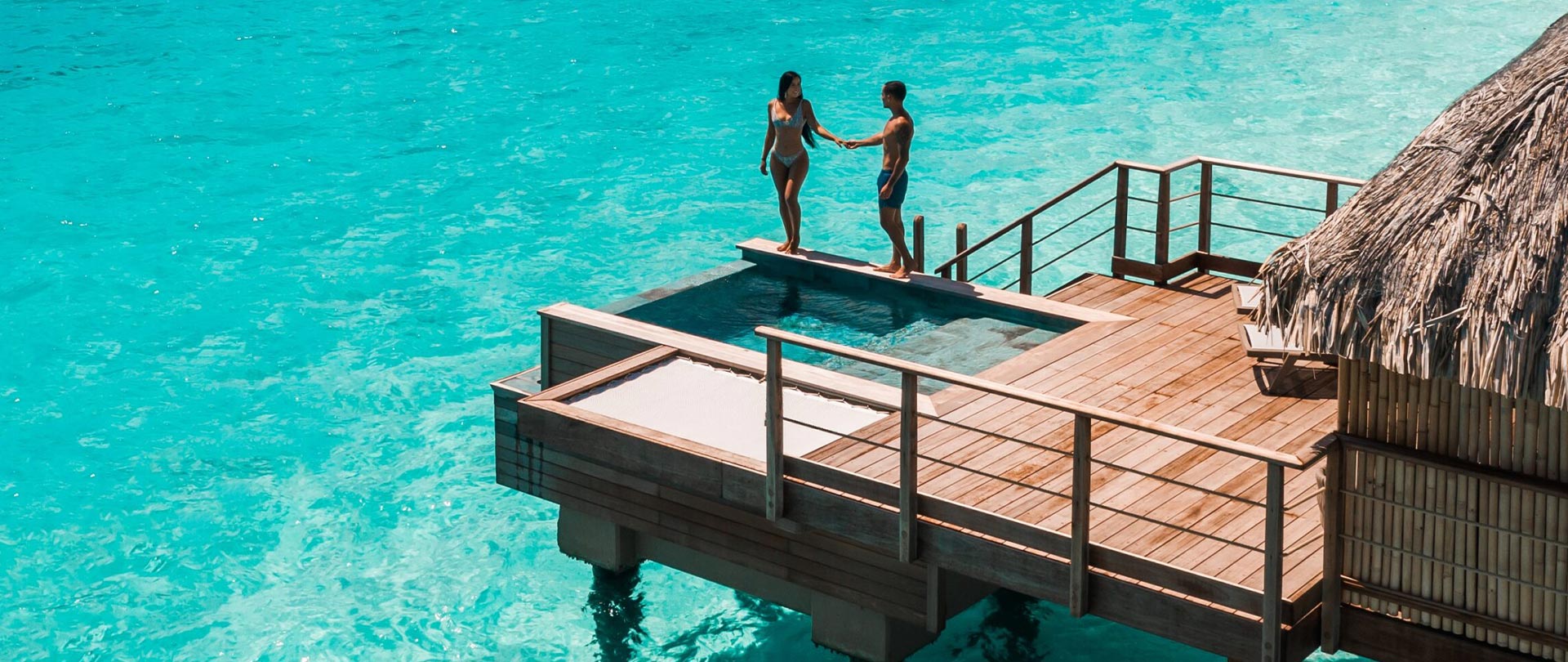
You’ve probably seen those beautiful floating houses. But did you know they were invented here, in Polynesia, in the 1960s? Symbolizing luxury and romance, the overwater bungalows were born in Polynesia in the 1960s. Three American hoteliers, known as The Bali Hai Boys, opened hotels in Moorea and Raiatea.
In 1967, Kelley had a revolutionary idea: to build rooms over the water! Inspired by fishermen’s huts, these bungalows with pandanus roofs and coconut pillar supports offer a unique view of the lagoon. Over 50 years later, they still capture imaginations.
Fun fact about tahiti : A language with only 14 letters

The Tahitian language, or reo tahiti, has an alphabet of 14 letters: five vowels (A, E, I, O, U) and nine consonants (F, H, M, N, P, R, T, V, and ‘, called ‘eta). The vowels are pronounced like in French, except for E (é) and U (ou). The R is rolled and the H is aspirated.
The famous “Bora Bora” is actually a transcription of Pora Pora, which means “firstborn”. The Tahitian Academy even offers the Reo app to explore this unique linguistic heritage.
Tattoos: a living identity
The word “tattoo” comes from the Tahitian word tatau. In the past, each design told the story of a person: their clan, their rank, and their deeds. A painful but essential ritual, it marked the passage into adulthood. More than just decoration, Polynesian tattoos symbolize identity and protection. Done with a bamboo needle, it remains a procedure without anesthesia.
🔱 In Tahiti, we smile at tourists who get tattoos lightly, but we respect those who embrace this tradition with meaning. Ready to take on the challenge? A tatau will be more than a souvenir: an indelible connection to the Polynesian soul.
The art of tahitian politeness
In Tahiti, fa’a’amu literally means “to adopt.” Inviting someone to share a meal? It’s the norm. But the ultimate gesture is the honi: a small nose rub to exchange mana (life energy). No handshakes here, just softness and a smile. And three kisses between close ones, one on the forehead. Not too affectionate, right?
A territory as large as europe, but with only 280,000 inhabitants

Polynesia is vast… truly vast. Yet it has fewer inhabitants than the city of Paris! And with its 118 islands, it’s a real mosaic of landscapes – from the Marquesas archipelago to the Tuamotu lagoons, it’s a journey into pure nature.
Would you dare to try raw fish with coconut milk for breakfast?
Raw fish is a tradition here, served everywhere, at any time, including breakfast! And if you’re brave, try fafaru, a fish marinated in seawater and coconut milk. Does that sound tempting to you? No? Well, there’s also noni juice, so bitter it might make you rethink twice. A true challenge for your taste buds!
Fascinating fun facts about tahiti: The Heiva, a competition of strength
Imagine this: you’re on a beach in Polynesia watching athletes lift giant stones. It’s normal! These are the competitions of Heiva i Tahiti, an annual festival of strength and courage. Javelin throwing, stone lifting… It’s way more impressive than your daily gym session, right?!
The Rahui: a forward-thinking ecological practice

Long before the world talked about ecology, the Tahitians practiced the rahuï, a temporary fishing or harvesting ban to allow natural resources to regenerate. It’s an ancestral wisdom now making a strong comeback to preserve this unique ecosystem.
Whales are the real stars of Tahiti!
From July to November, Tahiti becomes a luxury spa for humpback whales that come to calve in its warm waters. No pools or barriers here: you can watch them freely! Imagine hearing their enchanting song and seeing a 40-ton whale appear just a few meters away… A grand spectacle and an unforgettable experience for nature lovers.
A dance that tells stories
Tamure, with its fast hip movements, is the traditional dance of the Tahitians. Each gesture evokes a myth, a significant event, or a Polynesian legend. It’s a true form of body language that conveys the essence of Tahitian culture. Ready to try it?
Surprising fact about tahiti : Flowers replace engagement rings

In Polynesia, a tiare flower placed on the left ear means someone is taken, while on the right ear, it signifies they are single. A floral language far more poetic than our Facebook statuses! And where will you place your flower when you arrive on the island?
A unique hospitality
The Tahitians have a word for their natural generosity: fa’a’amu, which literally means “to adopt.” Inviting a stranger to share a meal, or even welcoming them into their home, is a tradition that’s deeply embedded in Tahitian DNA.
Bora Bora, the island of kings
Bora Bora was once a strategic military bastion. During World War II, the Americans set up a base there, leaving behind cannons that are still visible today.
Fascinating fact about French polynesia, where time stops
Here, the expression “Polynesian time” truly makes sense. The pace of life is slow, gentle, and connected to nature. People live with the rhythm of the sun, the marshes, and the song of the birds. A true return to essentials, rooted in Tahitian culture.
✨In conclusion: discover more curiosities about Tahiti on site!
At Tahiti Travel Services, we create custom trips to Polynesia that go far beyond the typical postcards. Embark on a unique experience and let Tahiti reveal all its secrets to you.